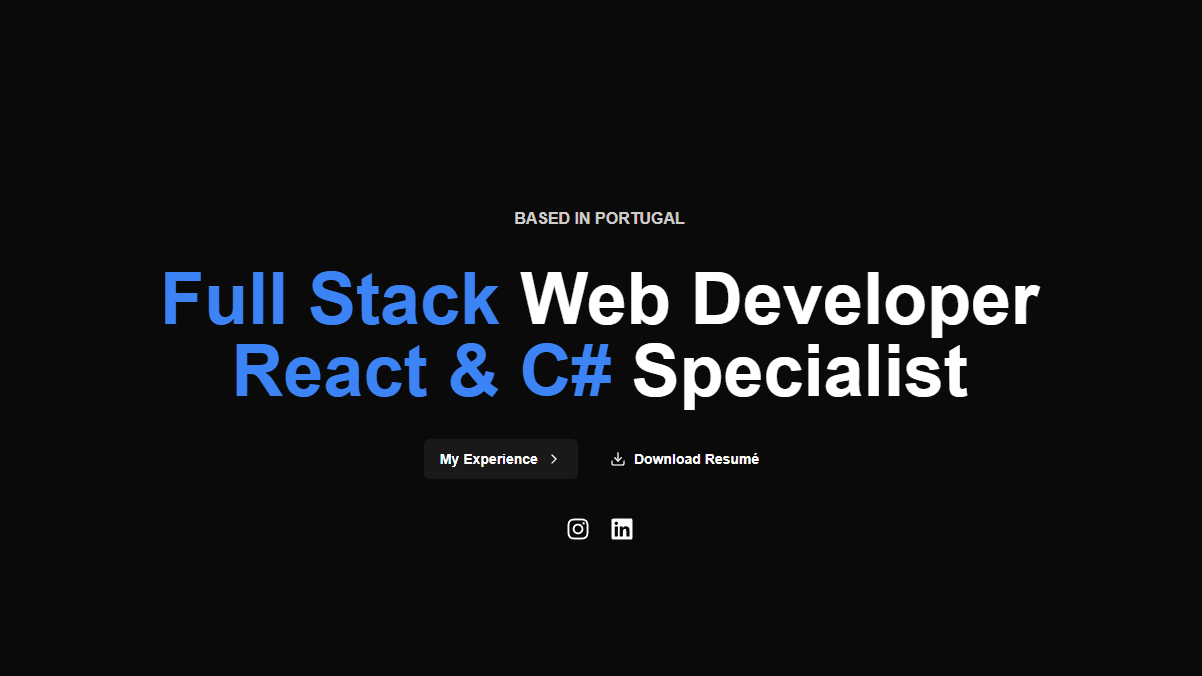
This was the first time I tried to build something that represented me online, and I did not really have a clear direction. I just knew I wanted a portfolio, and I wanted it to feel different from the typical clean and minimal developer pages I kept seeing. So I went the opposite direction and built something dark, a bit edgy, and visually heavier than it probably should have been.
At the time, I was mostly focused on the feeling of it. I wanted it to look “cool” in my head, not necessarily communicate anything structured. That led me to spend more time on visuals than on thinking about how someone would actually read or understand the content. There was no real narrative behind it, just sections that I thought made sense to include.
Tech stack and how I used it
From a technical point of view, I was already working with Next.js, TypeScript, and Tailwind CSS, so the implementation itself was not the hard part. Next.js was mainly what I used to structure the project and get it deployed quickly, especially with Vercel, which became my default way of shipping things. At least... Small projects like this one. The workflow of pushing to Git and seeing it live almost instantly made it very easy to iterate.
Tailwind CSS was mostly used to push the dark aesthetic I had in mind at the time. I was not thinking much about design systems or consistency yet, I was just using utility classes to get things looking the way I wanted. TypeScript was there because I was already using it in other projects, but I was not really leveraging it in a deep way for this specific build.
The stack itself was solid, but I was not using it with much intention. It was more about getting something visually complete rather than architecting it properly.
What was missing
The main issue was not the tools. It was how I approached the project. I was building it like a UI experiment instead of something that needed to communicate who I am as a developer. There was no structure behind the content, no clear flow, and no real explanation of my work or decisions. It was just sections placed in a way that felt visually balanced.
Looking back, it did not answer any real questions about me. It showed I could build and deploy something, but it did not show how I think, how I approach problems, or how I structure systems. It was more like a static page than a portfolio in the real sense.
What still mattered
Even with all of that, it still had value. It was the first time I used my actual stack in a personal project and shipped it properly. Next.js handling structure, Tailwind handling styling, TypeScript keeping things consistent, and Vercel making deployment frictionless. That combination started to feel natural, and it became the baseline for everything I built later.
More importantly, it changed how I approached personal work. Before this, I would build things and leave them local or unfinished. This was the first time I actually put something out publicly, even knowing it was not perfect. That shift mattered more than the result itself.
What I learned from it
It also made something very clear. Good design alone does not make a good portfolio. You can make something visually strong, but if it does not communicate thinking or context, it becomes empty very quickly. That realization is what pushed me to rethink everything later and rebuild it with more intention instead of just improving visuals.
Technically, it was still a good learning step. I understood better how I like structuring Next.js projects, how far I can push Tailwind before things get messy, and how smooth deployment with Vercel actually is when everything is set up properly. But conceptually, it was incomplete. It was missing context, which is the part that actually matters.
Even with its flaws, I would not remove it from my path. It was the first real version of something I shipped under my own name, and without it I probably would have spent way more time overthinking instead of actually building the next iteration.